The deal starts normally. You agree on 50% down and the balance against the bill of lading (the shipping document). You wire the deposit. Then the supplier says its bank requires full payment before export. It says it has had trouble with foreign orders before. It refuses your letter of credit (a bank’s promise to pay against shipping documents). It refuses every safer option.
Your project is falling behind, so you feel pressed to wire the rest. Then nothing ships.
That is what happened to an Indian buyer. It ordered 56 tonnes of zinc ingots from a supplier in Shandong. The price was USD 114,800, paid in full by August 2025. On 18 June 2026, a court in Jinan gave its judgment. It ordered every dollar returned, with interest. The judgment was published only in Chinese, so most foreign buyers cannot read it. Here is what it says and what buyers can learn from it.
How the dispute developed
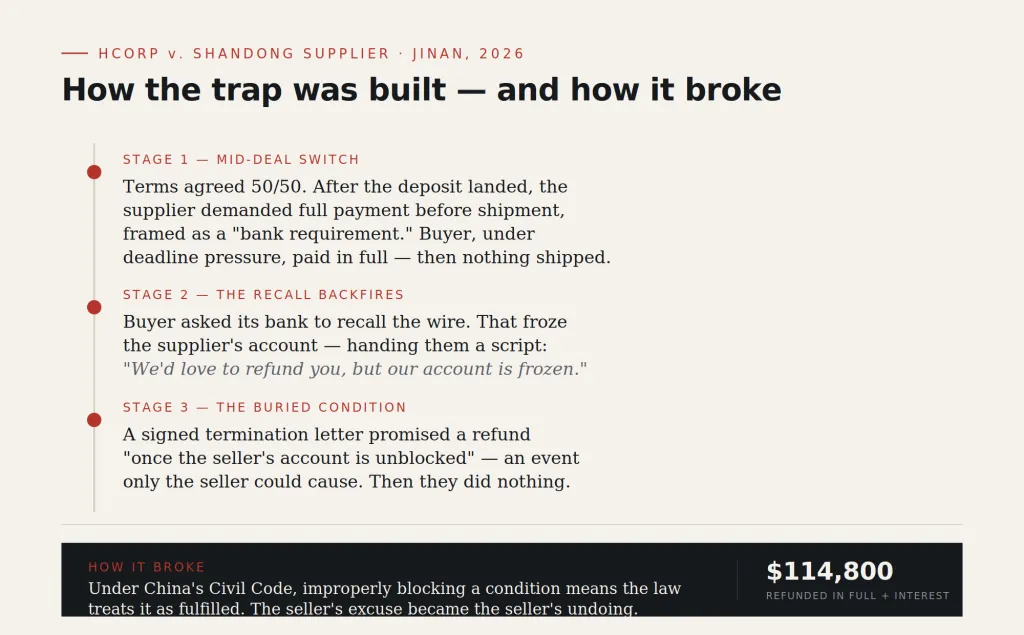
Stage one: the payment terms change. The contract said 50/50. After the deposit arrived, the supplier changed the terms on its own. It now wanted full payment before shipment, and said its bank required this. Changing payment terms after you have paid the deposit is one of the oldest pressure tactics in China sourcing. At that point, walking away means chasing the deposit back and losing the season.
Stage two: the recall that made things worse. The buyer had paid in full and received nothing. So it asked its bank to recall the second wire. After the recall request, the supplier’s bank in Hong Kong restricted the supplier’s account. The supplier then said it could not refund the buyer because its account was frozen. A payment recall is a real tool. But it can freeze the same account your refund has to come from. It can also give the other side an excuse that sounds reasonable and lasts for months.
Stage three: the condition the seller controlled. The buyer’s people flew to Jinan and met the supplier in person. They left with a signed Contract Termination Letter. That felt like a win. But the letter said the refund would be arranged “when the seller’s bank account is unblocked.” Only the seller could make that happen. The supplier then did nothing. It never sent the documents its bank asked for, and never followed up on the paperwork. The account stayed frozen, so the excuse stayed in place.
How the court dealt with the refund condition
China’s Civil Code has a rule most foreign buyers have never heard of. If a party improperly prevents a condition from being fulfilled, the law treats the condition as fulfilled. The court found the supplier had been deliberately passive. It couldn’t show it had sent a single document the bank asked for. So the judge treated the “account unblocked” condition as met. The court ordered the full USD 114,800 refunded, plus interest from the day the lawsuit was filed. It also awarded the buyer USD 731 in notarisation and legalisation costs. These are the costs of having foreign documents certified for use in a Chinese court.
The refund clause seemed to favour the seller. In the end, the seller lost because of it. The court applied a rule of Chinese contract law.
Three lessons from this judgment
1. The case was faster than you might expect. The case was filed on 5 January 2026. Judgment came on 18 June 2026. That is five and a half months from start to finish. It was in a district-level court, for a foreign buyer with no presence in China. Many people think suing a Chinese supplier takes years. It doesn’t have to, if your records are clean.
2. The records won the case. The buyer had a pro forma invoice (the invoice a seller issues before you pay) with the core terms. It also had wire records, a signed termination letter, and notarised and legalised documents. These were ordinary documents that a Chinese judge could read and rule on. At every step of this dispute, the buyer kept things in writing.
3. The buyer still lost its legal fees, and it did not have to. The court awarded the notarisation costs. It rejected the claim for lawyer’s fees. The contract had no clause providing for them, and the buyer submitted no proof of payment. In a contract claim in China, whether you recover legal fees generally depends on the contract. Without a fee clause, you usually don’t get them back. One sentence in the original agreement would have moved that whole cost to the supplier that broke the contract. Almost no foreign buyer’s template includes it.
What buyers can learn
The buyer in this case did several things right. It still spent most of a year, and a flight to Jinan, to get a judgment for its own money. Its protections were put together after the wire transfers. They should have been in place before. Three sentences would have helped. The first is a payment-terms clause the supplier can’t change on its own. The second is a clause on lawyer’s fees. The third is a refund obligation that doesn’t depend on the seller’s cooperation. They cost almost nothing to add before payment. They are very hard to get afterwards.
Questions from overseas buyers
Should I ask my bank to recall a payment to a Chinese supplier?
It can make things worse. Here, the recall request led the supplier's bank to restrict the supplier's account. That was the same account the refund had to come from. It also gave the supplier an excuse that sounded reasonable and lasted for months.
How long does it take to sue a Chinese supplier in China?
A first-instance case usually takes about six months if no expert testing is needed. This one took about five and a half months. The claim was filed on 5 January 2026, and judgment came on 18 June 2026. That was in a district-level court, for a foreign buyer with no presence in China. A timeline like this assumes your records are clean.
Can I get my lawyer's fees back from a Chinese supplier?
Generally only if the contract says so. Here the court rejected the buyer's claim for lawyer's fees. The contract had no fee clause, and the buyer gave no proof of payment. The court did award USD 731 in notarisation and legalisation costs.
What should I add to the contract before I pay a Chinese supplier?
Three sentences would have helped this buyer. One is a payment-terms clause the supplier can't change on its own. Another is a clause on lawyer's fees. The third is a refund duty that doesn't depend on the seller's cooperation.
Sources
Official texts cited in this article.
- Civil Code of the PRC (2020) npc.gov.cn
Has your supplier taken payment and gone quiet? Is it suddenly changing the terms mid-deal? Send me a message. Before you spend anything, I’ll tell you plainly where you stand and what your options are.
Adrian Liu is a PRC-licensed lawyer in Xiamen who mainly acts for foreign buyers. The case discussed is a published judgment of the Jinan Shizhong District People’s Court, (2026) Lu 0103 Min Chu No. 74, judgment of 18 June 2026. This is a first-instance judgment. No appeal appears in the published records. This article is general information on PRC law. It isn't advice on any particular matter.